How Did the SuperBall Capture the World’s Attention?
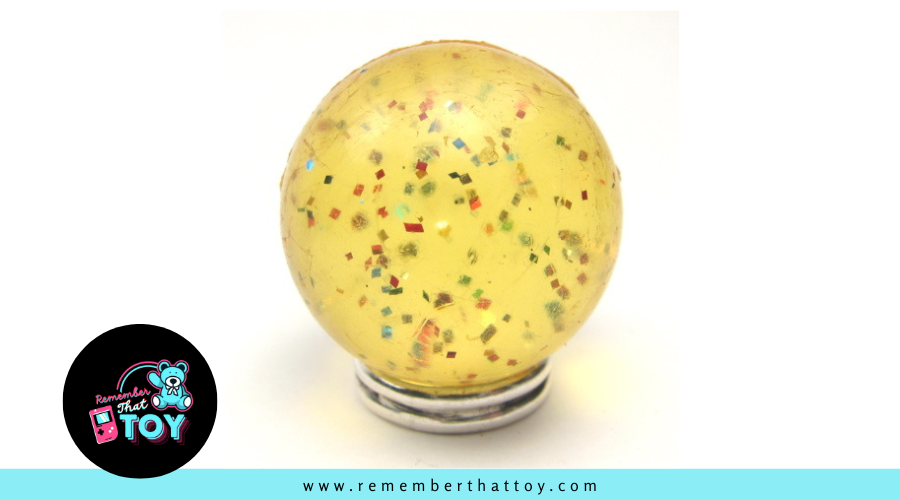
The Super Ball, invented by chemist Norman Stingley in 1964, transformed playtime with its exceptional bounce and elasticity. Crafted from a synthetic rubber called polybutadiene, this innovative toy quickly captured public interest. Stingley initially pitched the Super Ball to Bettis Rubber Company, but it was Wham-O that recognized its potential, mass-producing and marketing it to children everywhere.
By December 1965, over six million Super Balls had been sold, with production peaking at 170,000 units daily. Children everywhere were thrilled as they bounced these vivid spheres in streets, parks, and playgrounds. The Super Ball transcended its status as merely a toy, evolving into a symbol of fun and creativity. Its impact even extended to sports, inspiring Lamar Hunt to coin the term ‘Super Bowl’ in 1966, underscoring the toy’s cultural relevance.
Image Attribute: Lenore Edman, Glitter Super Ball, CC BY 2.0
Physical Properties
Super Balls exhibit exceptional elasticity, rebounding to approximately 92% of their drop height thanks to their unique synthetic rubber composition, Zectron. This high coefficient of restitution allows for impressive bounce heights that seem to defy gravity, with the potential to soar over three stories when thrown with sufficient force.
Here are three key features that make Super Balls fascinating:
- Unmatched Energy Retention: Each bounce retains about 90% of the energy from the previous drop, ensuring a consistently lively performance.
- Dynamic Motion: The textured surface creates complex bouncing patterns, making every bounce unpredictable and exciting.
- Enhanced Rebound: When a small ball bearing is placed on top, the Super Ball can rebound even higher, showcasing its remarkable energy transfer capabilities.
The combination of high elasticity and innovative synthetic rubber makes Super Balls more than just toys; they are marvels of physics. Their unique properties provide engaging interactions, offering joy and wonder to players of all ages.
Coefficient of Restitution
Understanding the coefficient of restitution is crucial, as it directly impacts the Super Ball’s ability to bounce back to impressive heights. With a remarkable coefficient of restitution of about 0.92, the Super Ball rebounds to 92% of the height from which it was dropped. This impressive elasticity means that it maintains kinetic energy with minimal loss upon impact, making it an excellent tool for physics demonstrations.
The unique synthetic rubber known as Zectron enhances this bouncing behavior, allowing the ball to consistently achieve high rebounds. Experiments show that the angle of incidence equals the angle of reflection, highlighting the predictability of its bounces even at high energy levels.
Interestingly, when you place a small ball bearing on top of the Super Ball during a drop, the coefficient of restitution enables it to rebound even higher. This occurs because the energy transfer amplifies the bouncing effect, demonstrating the Super Ball’s exceptional properties.
Energy Retention Efficiency
Super Balls retain about 90% of their kinetic energy after each bounce, demonstrating exceptional energy retention efficiency. This is due to their unique construction using the polymer polybutadiene, which enhances their elasticity and resilience.
When you drop a Super Ball, you can expect it to:
- Bounce nearly to its original height, with a high coefficient of restitution around 92%.
- Reach heights over three stories when thrown with sufficient force.
- Outperform traditional balls, like tennis balls, by bouncing significantly higher from the same drop height.
Their ability to conserve energy during impacts showcases the engineering marvel behind their design. Watching a Super Ball bounce is witnessing a tiny spectacle of energy retention. It’s not just fun; it’s a lesson in kinetic energy and elasticity.
Manufacturing Process
The manufacturing process of the SuperBall starts with polymerization, where butadiene molecules are bonded to form polybutadiene, a highly elastic synthetic rubber. This essential step ensures the SuperBall’s exceptional bounce and durability. Following polymerization, the mixture undergoes vulcanization, which enhances flexibility and resilience. During this process, polybutadiene is combined with 0.5 to 15 parts sulfur and heated to temperatures between 285 to 340 degrees Fahrenheit under pressures ranging from 500 to 3,000 psi.
Wham-O, the company behind the SuperBall, has refined Norman Stingley’s original formula to ensure the toy’s quality and longevity, distinguishing it from imitations. Their rigorous quality control means that each SuperBall meets strict standards. Upon completion of the manufacturing process, the final product measures approximately 1.875 inches in diameter. To verify authenticity, Wham-O embosses the Original SuperBall with a unique Zectron mark, guaranteeing you an authentic version of this iconic toy.
Physics Behind the Bounce
When you drop a Super Ball, its impressive bounce is due to a high coefficient of restitution, allowing it to return to 92% of its original height. This phenomenon is grounded in the principles of energy conservation and the specific properties of the ball’s material. Additionally, impact and friction significantly influence the ball’s behavior, leading to interesting effects such as spin reversal.
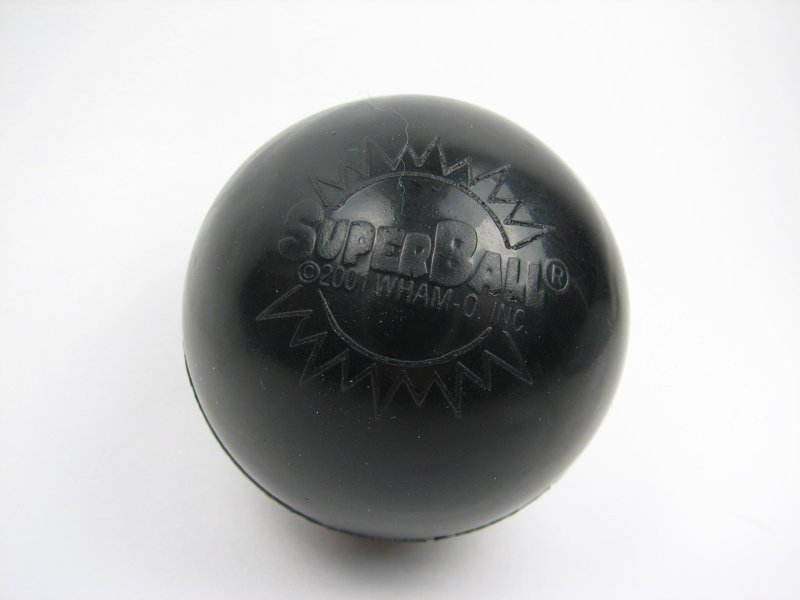
Lenore Edman, Black Super Ball, CC BY 2.0
Energy Conservation Principles
Energy conservation principles are central to the Super Ball’s impressive bounces, efficiently transforming potential energy into kinetic energy. When you drop the Super Ball from a height, its gravitational potential energy converts into kinetic energy during the fall, exemplifying the law of energy conservation—energy is neither created nor destroyed, only transformed.
Upon striking the ground, the ball compresses, storing elastic potential energy. Made primarily from polybutadiene, the Super Ball retains about 90% of its energy with each bounce. Instead of losing significant energy on impact, it efficiently releases its stored elastic potential energy, propelling it nearly back to its original height. This minimal energy loss makes the Super Ball one of the most efficient bouncing toys available.
Impact and Friction Effects
Examining the impact and friction effects reveals how the Super Ball’s design leads to its remarkable bounce performance and unpredictable behavior. With a high coefficient of restitution, the Super Ball bounces back about 92% of its drop height, showcasing minimal energy loss upon impact. This impressive feature, coupled with its unique surface texture, results in increased friction that contributes to its erratic bounce patterns.
Here are three intriguing aspects of this physics marvel:
- Energy Transfer: Upon impact, the ball converts kinetic energy into heat, temporarily increasing its temperature and affecting its elasticity.
- Spin Reversal: The friction between the ball and the surface can cause the ball to spin unexpectedly, creating surprising and varied trajectories.
- Rolling Dynamics: When dropped, the bottom of a rolling Super Ball can momentarily come to rest, revealing complex interactions between rolling and bouncing.
These effects illustrate the interplay of impact and friction, making the Super Ball not just a toy but a fascinating study of physics in action. When you throw it, you’re witnessing these principles come to life!
Cultural Impact
The SuperBall became a beloved toy in American culture during the 1960s, symbolizing innovation and playfulness in a rapidly changing society. With over 20 million sold between 1965 and 1970, it quickly became a cultural icon, found in households across the nation. Its popularity emerged in the post-Sputnik period, showcasing American ingenuity and competing with other fads like the Hula Hoop.
The unique, unpredictable bouncing behavior of SuperBalls captivated children and inspired countless hours of imaginative play. This fascination led to the creation of numerous bouncing toys that followed in its footsteps, influencing the toy industry for years to come. SuperBalls are referenced in numerous media and nostalgic retrospectives, further solidifying their status as a cherished childhood staple.
Interestingly, the term “Super Bowl,” coined in 1966, was inspired by kids playing with SuperBalls, underscoring the toy’s significant impact on American culture. The SuperBall wasn’t just a toy; it was a reflection of the fun and creativity of an entire generation. Its influence continues to inspire joy and laughter today.
Safety Considerations
While SuperBalls offer endless fun, their high bounce capability can lead to injuries if not used with caution. It’s important to be aware of the safety risks involved during play. Here are three potential hazards to consider:
- Injuries: High-speed throws can result in black eyes or bruises, especially if the ball hits a person or hard surface unexpectedly.
- Unpredictable Trajectories: SuperBalls can bounce off walls and return at unpredictable angles, potentially catching you or others off guard.
- Damage to Surroundings: Parents often worry about the ball damaging fragile items in indoor settings.
To minimize these risks, always aim away from people and delicate objects. Playing with SuperBalls in open areas provides ample room to maneuver. Encouraging children to use caution during play is crucial for ensuring a fun and accident-free experience. Remember, while the thrill of bouncing is enticing, prioritizing safety enhances enjoyment and prevents injuries.
Continuing Popularity
SuperBalls continue to enjoy widespread popularity thanks to their vibrant colors, unique bouncing properties, and nostalgic appeal that resonates with both longtime fans and new generations alike. Nearly 60 years after their debut, these rubber marvels still captivate audiences. Available in toy stores, online shops, and vintage collections, they prove to be more than just a fleeting trend.
With over 20 million units sold between 1965 and 1970 and continued academic interest—over 460,000 related entries on Google Scholar—it’s evident that SuperBalls are not just toys; they are cultural icons that stand the test of time.
Conclusion
exceptional bounce, powered by the unique properties of synthetic rubber, captured the imaginations of millions and left a lasting impact on both playtime and popular culture. From inspiring the name "Super Bowl" to becoming a staple in toy collections worldwide, the Super Ball’s legacy endures.