From Speak & Spell to Alphie: A Look Back at 80s Learning Toys
In the 1980s, learning toys like Speak & Spell, Teddy Ruxpin, and Alphie turned education into an engaging adventure. You'd find Speak & Spell offering clever spelling drills with phoneme synthesis, while Alphie taught problem-solving through interactive tasks.
Teddy Ruxpin became your storytelling buddy, sharing tales with a touch of wonder. These toys captured imaginations, encouraging a hands-on approach to learning. Investigate further to uncover how these icons reshaped educational play.
Key Takeaways
- Speak & Spell revolutionized educational toys with its phoneme-based speech synthesis and behaviorist principles for spelling drills.
- Alphie was another popular 80s learning toy, equipped with interactive features to enhance children's problem-solving skills.
- Speak & Spell's cultural influence extended into films and music, showcasing its impact beyond just an educational tool.
- View-Master's 3D storytelling and Disney collaborations set a precedent for integrating technology and popular culture in educational toys.
- The 80s saw educational toys like Speak & Spell and Alphie blending play with learning, paving the way for future edutainment products.
The Birth of Speak & Spell: Revolutionizing Educational Play
Although educational toys in the 1970s relied heavily on moving parts and analog technology, Speak & Spell broke new ground by delivering a digital approach to learning. You might be fascinated by how Texas Instruments engineers, including Paul Breedlove and Richard Wiggins, initiated this expedition in 1976.
With a modest $25,000 budget, they tackled the technical challenge of speech synthesis, creating a digital vocal tract model. This groundbreaking educational technology utilized the initial digital signal processing (DSP) chip, TMS5100, and linear predictive coding (LPC) for speech.
By processing the recorded voice of DJ Mitch Carr into phonemes, they achieved a no-moving-parts design. Speak & Spell set a new standard, replacing traditional toys with solid-state circuitry, forever changing educational play.
The single-chip DSP technology allowed real-time signal processing without delay, which made it possible for Speak & Spell to function efficiently as an educational tool. The introduction of speech synthesis technology with the TMC0280 chip enabled the Speak & Spell to deliver lifelike pronunciation, further enhancing its effectiveness as a teaching device.
Unpacking the Features of Speak & Spell
While the 80s saw an array of groundbreaking learning toys, Speak & Spell stood out with its pioneering features. By employing phoneme synthesis through the TMS5100 voice chip, it transformed human vocal recordings into digital phonemes, allowing for clear, spoken word output.
This innovation laid the foundation for engaging educational gameplay. Speak & Spell offered immediate feedback, using Skinnerian principles to praise correct responses, enhancing learning experiences. With its robust, no moving parts design, it guaranteed durability and reliability.
Multi-region adaptability allowed for language-specific cartridges, making it a versatile tool for different linguistic needs. Kinetic sand's moldable properties inspire creativity and imagination, much like Speak & Spell's engaging features did for language skills.
| Feature | Description | Impact |
|---|---|---|
| TMS5100 Voice Chip | Initial single-chip speech synthesizer | Clear pronunciation |
| Phoneme Synthesis | Converts human voice to digital | Accurate spoken words |
| 128 Kbit ROM Storage | Largest capacity for speech data | Extensive vocabulary |
| Skinnerian Feedback | Verbal praise for correct answers | Encouraging learning |
| Multi-region Adaptability | Localized language cartridges | Broader educational reach |
The Educational Impact of Speak & Spell
The Speak & Spell changed the educational landscape by integrating behaviorist principles into its design, aiming to automate spelling drills through repetition and immediate feedback. It focused on spelling retention by using contingencies of reinforcement, giving praise for correct answers and avoiding punitive measures.
The Speak & Spell was one of the first portable gaming systems to use cartridges, enabling expanded vocabulary and features. You'd find its behaviorist learning approach emphasized rote memorization, offering immediate visual and audio confirmation, but lacking adaptability to different learning needs.
This meant spelling gains were often temporary, fading once the device was no longer in use. Though it provided a structured learning environment, it didn't cater to broader literacy skills or individual growth. Without addressing comprehension or phonemic awareness, the Speak & Spell's educational impact was largely supplementary, not a standalone solution.
Incorporating pretend play into learning can enhance memory and real-world understanding, which the Speak & Spell did not emphasize.
Cultural Legacy and Influence of Speak & Spell
- Featured in E.T. the Extra-Terrestrial(1982)
- Inspired Depeche Mode's debut album title (1981)
- Used in circuit-bent music
- Appears in synthpop aesthetics
- The Speak & Spell was a popular learning toy in the late 70s and 80s, providing an engaging and educational experience for children.
The Technological Innovations Behind Speak & Spell
Although many remember the Speak & Spell for its educational impact, its technological innovations were likewise groundbreaking. You'd marvel at LPC technology, which introduced the TMC0280 chip—the initial single-chip voice synthesizer.
This allowed phonemes to be processed into speech without tapes, using 128 Kbit ROM, the largest capacity then. Its modular design featured an integrated CPU, display, and expansion port. Swapable cartridges enabled diverse languages. In 1971, Texas Instruments introduced the first microcontroller, which laid the foundation for innovations like the Speak & Spell.
| Feature | Description |
|---|---|
| LPC Technology | TMC0280 chip, phoneme-based speech synthesis |
| Modular Design | Integrated CPU, keyboard, VFD display |
| Speech Synthesis | 1k bits/sec, clarity-focused processing |
| Portability | Handles, battery/AC adapter options |
These innovations paved the way for TI's future advancements, making Speak & Spell a pioneer of interactive learning tools.
Teddy Ruxpin: The Storytelling Companion
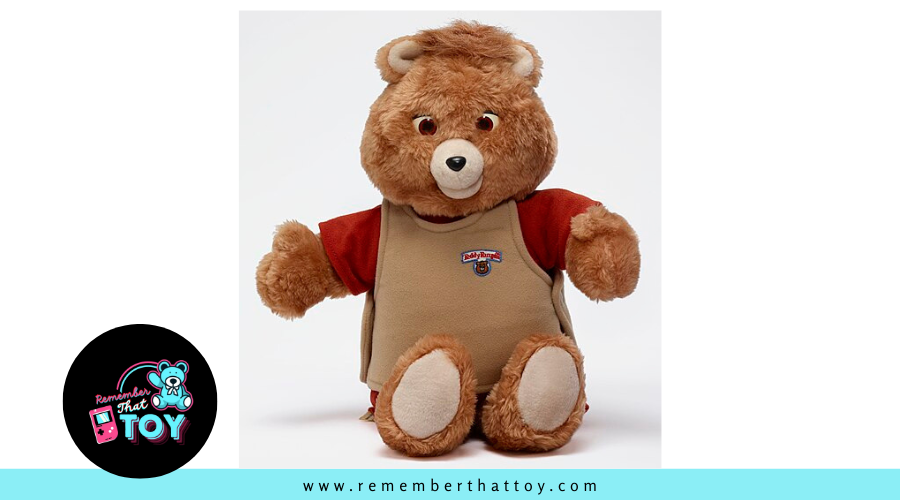
Inspired by the enchanting world of Disney animatronics, Teddy Ruxpin emerged as a mesmerizing storytelling companion for children in the mid-80s. Created by Ken Forsse, this animatronic marvel captivated young audiences with its unique storytelling mechanics.
Utilizing advanced animatronic technology, Teddy Ruxpin synchronized eye and mouth movements with cassette tapes, creating an engaging interactive experience. The innovation lay in its dual-track cassette system: one track played audio while the other sent commands to servo motors, bringing stories to life.
Pioneering interactive play, Teddy Ruxpin set the stage for future storytelling toys by enhancing imagination and literacy among children. Initially launched by World of Wonder in December 1985, Teddy Ruxpin quickly became the Toy of the Year, a testament to its innovative design and widespread popularity.
A captivating storytelling companion, Teddy Ruxpin enchanted children with synchronized movements and engaging tales.
- Released in December 1985 by World of Wonder
- Primary success with $93 million in inaugural-year sales
- Faced reliability issues in later models
- Revived in 2017 with modern updates like LCD-screen eyes
Teddy Ruxpin's legacy endures as a beloved icon of 80s learning toys.
View-Master: Early Virtual Reality for Kids
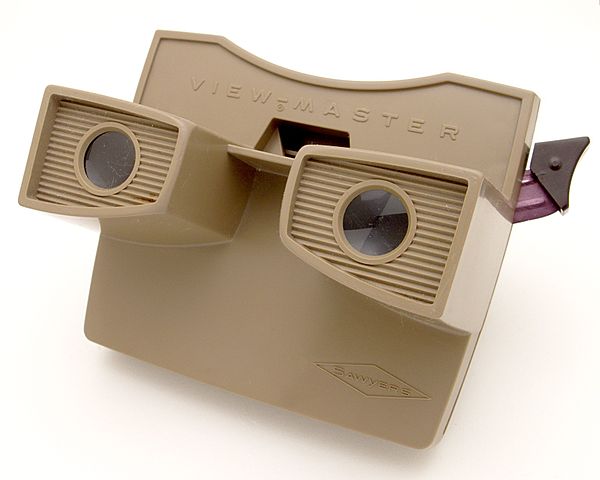
The View-Master emerged as a groundbreaking innovation for children, offering an early form of virtual reality through its stereoscopic reels. By inserting reels into the viewer, kids entered domains of stereoscopic storytelling, experiencing vivid 3D images.
Each reel, boasting seven pairs of film transparencies, transformed static scenes into engaging adventures. Originally launched in 1939 with Kodachrome film, the View-Master evolved, integrating Disney and Hollywood themes, turning simple image viewing into early gaming experiences.
Children could investigate everything from Mickey Mouse's escapades to iconic movie moments like E.T. The compact, portable design made it a favorite at gift stores and scenic spots.
As the technology advanced, it influenced future VR developments, carving its niche in the sphere of educational toys. During the 1950s, the View-Master expanded its reach by acquiring rights to Disney properties, which included reels featuring Disneyland. It laid the groundwork for future media-influenced toys, establishing a link between popular entertainment and playtime experiences.
Frequently Asked Questions
How Did Alphie Contribute to Educational Play in the 1980s?
View this post on Instagram
You might remember Alphie as a crucial educational toy from the 1980s that contributed greatly to interactive learning and cognitive development. By using interchangeable cards for subjects like math and spelling, it engaged you with fun, hands-on learning.
Alphie's immediate feedback through sounds and lights kept you motivated and reinforced correct answers. As a pioneer in electronic toys for preschoolers, it laid the groundwork for future educational innovations.
What Were Some Popular 80s Learning Toys Similar to Speak & Spell?
You're diving into the world of 80s learning toys, seeking alternatives to Speak & Spell. You'll find Simon Says, an engaging memory game, and Learning Resources products, which provided hands-on educational experiences.
Electronic Toys like VTech offered interactive learning, while Educational Games such as Rubik's Cube challenged problem-solving skills. These toys didn't just entertain; they educated, making learning an exciting adventure for kids of the 80s.
How Did Teddy Ruxpin Enhance Storytelling for Children?
You experienced storytelling like never before with Teddy Ruxpin. By merging interactive narratives with character engagement, Teddy brought stories to life. His synchronized audio and facial animations made you feel part of his adventures.
As Teddy's eyes moved and his voice matched his expressions, you couldn't help but be captivated. He encouraged you to turn pages and plunge deeper into the story, enhancing your imagination and attention span.
What Materials Were Used in the Construction of Speak & Spell?
When you look at the construction of Speak & Spell, you'll notice it features a brightly colored plastic casing that makes it durable and portable. Inside, the electronic components are essential, with solid-state circuitry that guarantees longevity.
The absence of moving parts means fewer breakdowns, and the use of styrofoam and plastic clips holds everything in place. This thoughtful design made Speak & Spell both a robust and iconic educational toy.
How Did the View-Master Evolve Over the Decades?
You're curious about how the View-Master evolved over the decades, aren't you? It started with simple round viewers in 1939, then transformed with the nearly indestructible Model C in the 1950s. Over time, it welcomed diverse View Master designs, including stereo projectors and themed character viewers.
These changes sparked nostalgic experiences for generations. Despite modern quality concerns, its legacy remains strong, thanks to iconic partnerships like Disney and memorable scenic reels.